Today's hours: Closed

 네이버지도
 카카오맵
 구글지도
 TMAP

Infertility Story
We accurately identify the causes of infertility
From identifying the cause to developing a treatment plan, we examine factors specific to both women and men to ensure an accurate diagnosis.
What is Infertility
Infertility is defined as the inability to conceive despite having regular sexual intercourse without using contraception.
Generally, it is recommended that women under the age of 35 undergo an infertility evaluation after one year, and those 35 and older after six months.
Since a woman’s age has a significant impact on fertility, it is important to undergo testing at the appropriate time.
Infertility Facts
Infertility is not uncommon.
There are various causes of infertility, and both female and male factors can play a role.
1 in 6
According to the World Health Organization (WHO), about 1 in 6 adults worldwide experiences infertility at some point in their lives.
- Gender Factors
- Male Factors
- Multiple factors
- Cause unknown
Female Factors
Causes of Female Infertility
The fallopian tubes are the passages through which the egg and sperm meet to form a zygote, and through which the embryo travels to the uterus. If the fallopian tubes are blocked or there are adhesions in the surrounding area, it can be difficult to conceive naturally; causes may include pelvic infections, endometriosis, or post-surgical adhesions.
For a normal pregnancy, a mature egg must be released from the ovary at the appropriate time. Ovulation disorders can result not only from medical causes such as polycystic ovary syndrome, hormonal imbalances, and premature ovarian failure, but also from factors such as sudden weight changes, excessive exercise, and severe stress.
The structure of the uterus and the condition of the endometrium are crucial for the embryo to implant in the endometrium and for the pregnancy to be sustained. Intrauterine adhesions, endometrial polyps, uterine fibroids, uterine malformations, and endometritis can affect implantation or the maintenance of pregnancy, depending on their location and severity.
This condition refers to cases where clear, abundant mucus—which is normally secreted from the cervix during ovulation to facilitate the passage of sperm—is not secreted properly; it accounts for about 1% of all infertility cases. Causes include cervical surgery and chronic cervical inflammation; it also includes cases where anti-sperm antibodies are present in the cervical mucus, preventing sperm from entering the uterus.
Intra-abdominal factors refer to cases in which pregnancy cannot occur because the fallopian tubes are adhered to surrounding tissues or other organs in the pelvis; causes include pelvic inflammatory disease, endometriosis, and postoperative adhesions.
When the husband’s semen is normal and the woman’s reproductive organs are also normal, the cause may be immunological. This occurs when the semen or sperm acts as an antigen, triggering the production of antibodies in the woman’s body.
This refers to cases where no abnormalities are found during infertility testing, and it accounts for about 10% of infertility causes. Immunological factors account for a significant portion of these cases.
Male Factors
Causes of Male Infertility
This condition occurs when the testicles do not produce enough sperm or when sperm do not mature normally. Major causes include genetic factors, undescended testicles, varicoceles, inflammation or injury to the testicles, and cancer treatment or radiation therapy.
Sperm production is influenced by hormonal regulation through the hypothalamus–pituitary–testis axis. In addition to hormonal imbalances, overall health—including certain medications, the use of exogenous androgens, chronic diseases, and obesity—can also affect sperm production and function.
Even if sperm are produced normally, they may not be expelled in the ejaculate if the passageways—such as the epididymis or vas deferens—are blocked. The main causes include congenital absence of the vas deferens, obstruction due to infection or surgery, and vasectomy.
If there are problems with erection or ejaculation, sperm may not be delivered to the female reproductive tract, which can lead to difficulty conceiving. Common causes include retrograde ejaculation, ejaculatory disorders, and erectile dysfunction.
Examination
Infertility Testing
The following are the health screenings you should undergo in advance while preparing for pregnancy, either before marriage or in the early stages of marriage.
Basic Women's Health Screening
- 01
Ovarian Function Test
Blood tests are used to evaluate ovarian reserve and function—including AMH (anti-Müllerian hormone)—to assess the current condition of the ovaries and help guide future treatment plans.
- 02
Female Hormone and Thyroid Tests
Blood samples are collected in accordance with the menstrual cycle to measure levels of follicle-stimulating hormone (FSH), luteinizing hormone (LH), estradiol (E2), and thyroid-stimulating hormone (TSH) to assess ovulation status, ovarian function, and any hormonal imbalances that could affect pregnancy.
- 03
Pelvic Ultrasound Exam
A transvaginal ultrasound is used to examine the shape of the uterus and ovaries, the number and size of follicles, and check for any abnormalities—such as uterine fibroids or ovarian cysts—that could affect pregnancy.
- 04
Evaluation of the Condition of the Uterus and Fallopian Tubes
A hysterosalpingogram (HSG) or ultrasound-guided examination is used to observe the movement of the contrast medium or injection fluid to assess the shape of the uterine cavity and determine whether the fallopian tubes are open.
- 05
Pre-Pregnancy Basic Blood Tests
Blood tests are used to assess whether you have anemia, as well as to check for rubella antibodies, hepatitis B, and other infections and immune statuses that need to be evaluated before pregnancy.
- 06
Infection-Related Tests
If necessary, we will check for infections—such as sexually transmitted infections (STIs)—that could affect pregnancy and treatment by collecting vaginal and cervical swabs or performing blood tests.
Basic Health Screening for Men
- 01
Medical History and Initial Evaluation
We review medical history, surgical history, current medications, and lifestyle habits such as smoking and drinking, and, if necessary, conduct a physical examination to assess factors that may affect male fertility.
- 02
Comprehensive Semen Analysis
After a 3- to 4-day abstinence period, a semen sample is collected, and the overall condition of the sperm is assessed using a microscope and analytical equipment to evaluate semen volume, sperm concentration, motility, and morphology.
- 03
Additional diagnostic tests, if necessary
Depending on the results of the semen analysis or your treatment history, additional tests—such as blood-based hormone tests, sperm DNA damage testing (SDF), and anti-sperm antibody testing—may be performed on a case-by-case basis.
Conception
The Course of a Normal Pregnancy
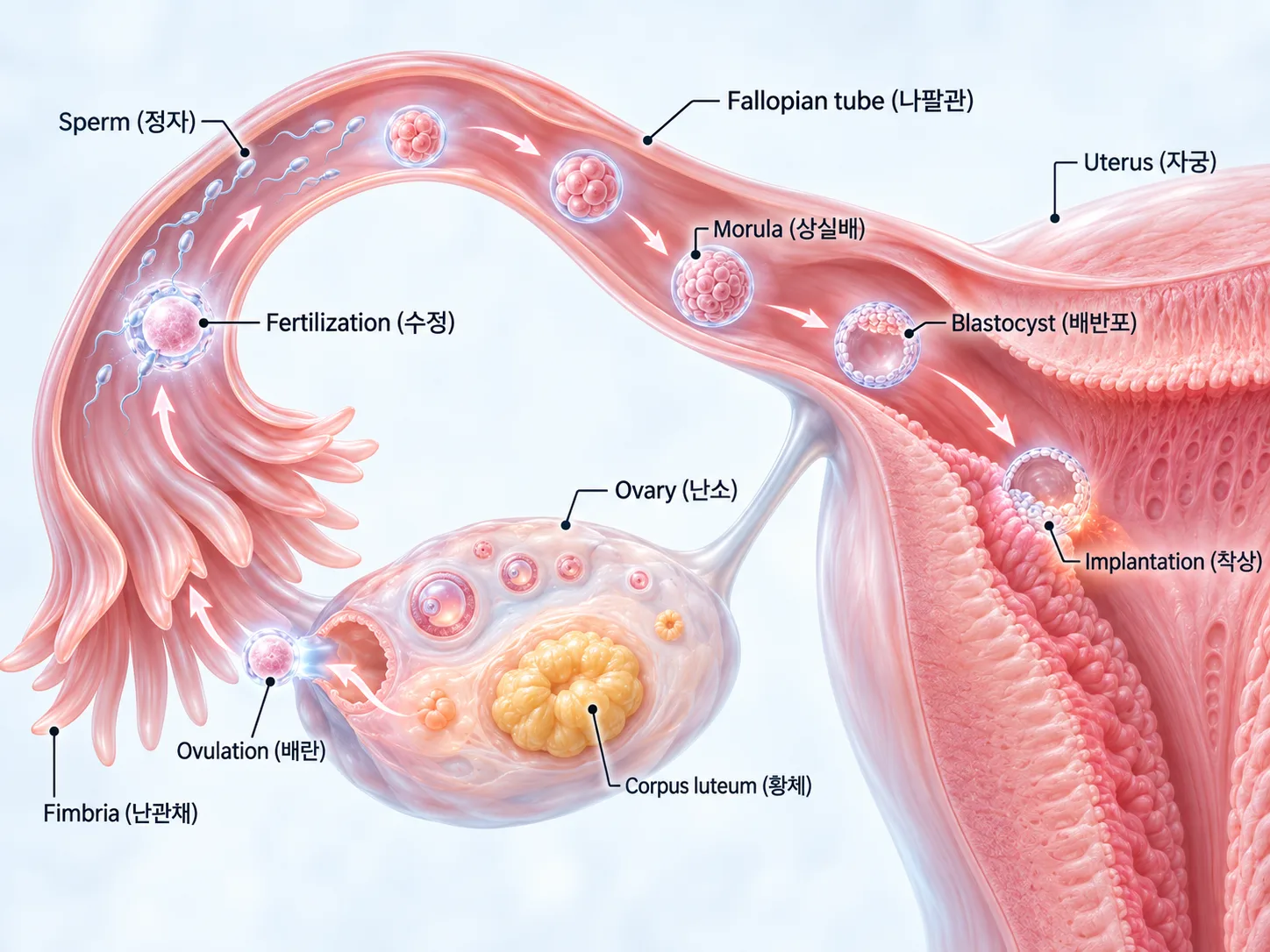
During a woman’s menstrual cycle, several follicles in the ovaries grow under the influence of hormones, and as one of these follicles matures, ovulation occurs. The released egg travels from the ovary to the fallopian tube, where it meets sperm introduced through sexual intercourse, resulting in fertilization. The fertilized embryo undergoes repeated cell division as it travels along the fallopian tube toward the uterus, developing into the blastocyst stage over approximately 5 to 6 days.
Once it reaches the uterus, the embryo implants itself into the thickened endometrium. If implantation is successful, pregnancy is established; the implanted embryo then develops into a fetus, and the placenta forms simultaneously.
Conversely, if implantation does not occur, the uterine lining—which had thickened in preparation for pregnancy—sheds, causing bleeding; this process is called menstruation.
Treatment
Infertility Treatment
Predicting Your Ovulation Date
To determine the ovulation date, ovulation is induced using ovulation-inducing medication (oral), and the ovulation date is then determined.
Artificial Insemination
IUI : INTRAUTERINE INSEMINATION
This method involves collecting the husband’s semen during the wife’s ovulation period, processing it to isolate only high-quality sperm, and then injecting it directly into the woman’s uterus through a thin tube to allow natural fertilization to occur.
View MoreIn Vitro Fertilization (IVF)
IVF-ET : In Vitro Fertilization and Embryo Transfer
A method of attempting to achieve pregnancy by administering ovulation-inducing medications to stimulate the growth of multiple eggs, retrieving the eggs, selecting only the most motile sperm from the partner’s sample to fertilize the eggs in a test tube (in vitro), culturing the embryos in an incubator for 2 to 5 days, and then transferring them to the uterus.
View More
I believe in your potential today, too
Until that possibility becomes a reality, we’ll be right by your side.